Are Large AI Data Centres The Next Big Challenge For Commercial Cleaning Contractors?
Cleaning TipsNext time you are inside a new AI hall, get down on the slab at the end of a rack row, beside the coolant distribution unit, and look for a thin sensing cable clipped to the floor and run in a loose serpentine around the unit’s feet. That is leak detection cable. It alarms on contact with conductive liquid, and there will be spot sensors to go with it, sitting under the quick disconnects and in the drip trays beneath the manifolds.
Now think about a mop bucket.
That is the job you are being invited to bid for, and the first thing to understand is that almost nothing you know about data centre cleaning from ten years ago applies to it. There is no raised floor. At 100kW and above per rack the plenum has no cooling function, so the AI-era default is slab-on-grade with power busway, coolant supply and return headers and cable tray all routed overhead. No tiles to lift, no subfloor to vacuum, no pedestal heads.
I have watched a great many London commercial contractors add a data centre cleaning page to the website, buy an H14 vacuum, and start bidding. The page and the vacuum are the whole of the capability, and the method statements I have seen attached to those bids describe lifting floor tiles in a building that does not have any. This became a marketing category considerably faster than it became a competence.
What gets cleaned in a new AI hall?
Everything is overhead or vertical, and very little of it is floor.
Above you: busway, coolant headers of 150mm diameter or more, fibre and network tray. Those runs collect settled particulate and they sit directly above open rack tops. In front of you: rack faces, containment doors and roofing, CDU enclosures, rear door heat exchanger coil faces, and filter faces on anything still moving air. The slab is the easy part and the smallest part of the hours.
All of it dry or near-dry. Lint-free wipes, no polish, nothing with silicone in it, no product that will off-gas into a room of intake fans. Vacuums filtered at H13 or H14 with ESD-safe hosing, because a standard plastic hose moving dry particulate builds a charge quite happily.
The standard you will be measured against is ISO 14644-1, most often Class 8, borrowed from cleanroom practice. Your work gets graded by a particle counter rather than by a facilities manager running a finger along a surface, and there is no talking your way past a count.
So what happened to the underfloor work?
It went out with the design, and a good deal of the market has not noticed.
If a tender for one of these buildings specifies subfloor plenum cleaning on a frequency, either it has been copied from a legacy colo specification that nobody technical has read, or the hall is a retrofit AI zone in an older building, which is a different job again.
Ask at site visit stage. Slab or raised floor, air or direct-to-chip, what is overhead. Those answers change your labour model completely, because the work has moved from crawling to working at height.
What goes wrong when a generalist crew does it?
This is the section that matters, because the failure mode here is an outage rather than a complaint. In an office a bad clean produces an email. Here it produces an incident number, a root cause investigation with your company named in it, and a liability conversation your public liability cover may not comfortably reach.
Start with the leak detection, because it is the new risk and the one nobody in general cleaning has ever met. That sensing cable and those spot sensors are tuned to catch a few drops from a quick disconnect before a leak spreads along a cable route and appears somewhere unexpected. They cannot distinguish your damp mop from a manifold weep. A tipped wet vac or a spray bottle overshooting a rack door can put the loop into alarm, and depending on how the site has configured its response, that can mean isolation valves closing on a cooling circuit while GPUs are at load.
The mitigation is a defined exclusion distance from every sensing run, spelled out in your method statement, plus liquid volumes controlled at source. Pre-moistened wipes issued by count rather than bottles and cloths. Nobody carries an open container of anything in the hall.
Then the overhead work, which has replaced the underfloor work as the physical risk. Cleaning busway tops and header runs means access equipment inside a cold aisle that may be 1,200mm wide, between two rows of live racks worth more than the building most of your operatives clean by day. A dropped tool onto a busway is an arc flash conversation. Foreign object control earns its paperwork here: tools and consumables counted in, counted out, signed for, and a lost item stops other people’s work until it is found.
Then airflow, which survives from the old world in a new form. Containment doors get propped open for a hose and left. Blanking panels get lifted out by crews who take them for dust covers. Brush seals at cable entries get pushed aside. Every one of those is a bypass path that sends cold air somewhere other than through the equipment, and the temperature rise happens in a spot where nobody is standing.
Then aspirating smoke detection, which samples air continuously through a pipe network and runs orders of magnitude more sensitive than the point detectors in an office ceiling. It exists to catch the first products of overheating cable insulation. A crew disturbing settled particulate along an overhead tray run can push it into alarm with no smoke anywhere in the building. The zone covering your work gets isolated by the site’s own team before you start, with a documented time out and time in. If nobody on your crew knows to ask for that, you should not be in the hall.
And the ordinary things that are extraordinary here.…
Why Are There Grey Shadows on the Ceiling Tiles Above the Desks?
Cleaning Tips“It looks like someone’s been up there with dirty hands.”
That was a practice manager in Hatton Garden, standing under a run of tiles in EC1N with grey bands running along every grid line and a soft dark halo around each supply diffuser. She had it in her head that the cleaners had been leaning on the ceiling. Nobody had touched it. The marks had arrived by air, over about four years, and they had arrived in a pattern so regular that once you know what you are looking at you can read the building’s ventilation from the floor.
What she was looking at is usually called ghosting, or plate-out, and it is one of the few problems in this trade where the honest answer is that cleaning is the wrong tool.
What is putting the grey there?
Fine airborne particulate landing on a surface that is very slightly colder than the air around it.
The mechanism is thermophoresis. Sub-micron particles get pushed down a temperature gradient, from warm towards cool, because the gas molecules on the hot side of a particle strike it harder than those on the cold side. Small force, slow work – which is exactly why the result is a faint even grey rather than a splash. The particles are too light to settle out under gravity in any useful time, so they drift until they find somewhere colder to stick.
Once a particle lands on a fibrous surface it is not coming off again in the way dust comes off a desk. It has keyed into the texture. The tile is the filter.
Why does it follow the grid lines and the diffusers?
Because those are the cold spots and the turbulent spots.
The exposed grid is steel. Steel conducts heat far better than a mineral fibre tile does, so the grid and the strip of tile immediately adjacent to it run measurably cooler than the middle of the tile, and the deposition concentrates there. That gives you the grid-following bands, and it is the same physics that produces thermal tracking lines on plasterboard ceilings above unfilled joists in flats.
Around the diffuser you get a second effect on top of the first. Air leaving a supply diffuser is cooler than room air and it is moving fast, so you have both a temperature gradient and turbulent impaction driving particles onto the tile face in the throw pattern of the jet. The halo takes the shape of the diffuser’s air pattern rather than a neat circle, which is why four-way blow gives you a rough cross and a linear slot gives you a stripe.
Stand under it and look at which way the smudge points. You will know within ten seconds whether the grille is throwing evenly.
Where is all that particulate coming from?
Three sources cover almost every London office I inspect, and they are not equally weighted.
Combustion products from outside dominate. Diesel particulate is overwhelmingly sub-micron, it comes in through the fresh air intake and through every door onto the street, and in a building on Clerkenwell Road with a taxi rank outside there is a constant supply of it. This is the one nobody can do much about beyond filtration, and it is the one that produces the broad even greying across a whole floorplate.
Then there is whatever the occupants are burning. Candles are the great unacknowledged culprit in small offices and in reception areas, and a cheap paraffin candle with an oversized wick produces staggering quantities of soot. Reed diffusers and oil burners are worse than people think. In Hatton Garden specifically the picture is different again, because the workshops upstairs are running polishing motors that throw rouge and tripoli compound into the air alongside the burnout kilns, and that workshop load finds its way into the ceiling void of the office below through service penetrations that were never sealed.
Laser toner is the third, and it is the one people always name first.
Is the printer to blame?
Partly, and less than its reputation suggests.
A laser printer emits ultrafine particles during fusing, mostly volatile compounds from the toner resin that condense into particles rather than toner powder itself escaping. The emission is real and it is measurable. What it produces on a ceiling is a localised darkening in the bay above and slightly downstream of the machine, rather than the floor-wide greying most clients blame on it.
If the staining is uniform across 3,000 square feet, the printer is not your problem and moving it will not help. If there is one noticeably darker bay above the print room door, move the machine and put it somewhere with a local extract.
Why does cleaning a mineral fibre tile usually wreck it?
Because you are cleaning a soft, absorbent, air-permeable board that was never designed to be wet.
A standard mineral fibre tile is compressed mineral wool with a binder, faced with a thin painted or fissured decorative layer. In a plenum return system, air passes through the tile itself. The tile is the filter, and it has been filtering for years, so the soiling sits within the surface layer rather than on top of it.
Wet cleaning does four things, all bad. Water swells the binder and the tile sags in the grid, sometimes visibly within a day. The surface nap lifts and the fissured texture roughens, so the tile holds soil faster afterwards. You get tide marks at the wet edge that are more conspicuous than the original stain. And if you lift enough soil to make a difference, you lift some of the surface coating with it, leaving a patch of different sheen.
Then there is the performance question that nobody asks. That tile has a declared fire classification and a declared sound absorption value, both of which depend on its surface and its perforation. Coating it, painting it or soaking it changes both. A ceiling that has been rolled with emulsion to hide staining has usually lost a chunk of its acoustic absorption and may no longer meet the classification it was specified under.…
How Do You Sign Off a Builders Clean Before a Cat B Office Handover?
Cleaning TipsYou do not sign it off before the air conditioning has been commissioned. That is the whole article, and everything below is the argument for it.
The pattern is the same on every Cat B fit-out I have worked on in fifteen years. The main contractor is chasing practical completion, the client’s project manager wants a walk round on the Thursday, and the cleaning contractor is asked to have the floor sparkling by Wednesday night. Then the mechanical subcontractor runs the fan coil units up to full speed on the Friday for air balancing, and eleven weeks of construction dust comes out of the ceiling void and settles across 8,000 square feet of new desking.
Everybody blames the cleaners. The cleaners were there on Wednesday and the floor was immaculate on Wednesday.
What is the difference between a builders clean and a sparkle clean?
Three stages, and most fit-out programmes budget for two of them.
The first clean, sometimes called the rough clean or the builders clean proper, happens when the wet trades are finished and before decoration and floor finishes go down. It is heavy work: debris removal, plaster and screed residue, adhesive spots, silicone off glass, wet vacuuming of the slab or the raised floor panels. Nobody photographs this stage and nobody appreciates it, which is a shame, because a floor that gets a proper first clean needs a third less time at the end.
The second clean sits after the finishing trades and before commissioning. Cores, WCs, tea points, ironmongery, the top faces of everything.
The sparkle is the final pass. Glass both faces, all horizontal surfaces, floor finish machined or buffed as specified, ironmongery polished, then the floor is closed. The word “sparkle” has become a bit of a con in this trade, because it gets sold as a distinct high-value service when most of what it contains is a second clean done properly, with better lighting and more time. If you are being quoted a large number for a sparkle on a floor that never had a first clean, you are paying twice for the same soil.
Where does the money go?
Glass and edges. Not open floor. On a typical Paddington Basin floorplate with a full-height glazed perimeter and internal glazed offices, the glazing is somewhere near two-thirds of the labour hours, and the recessed detail – shadow gaps, skirting reveals, the underside of raised floor cut edges around trunking – takes most of the rest. Open carpet is quick. It is the last thing to worry about and the first thing everyone looks at.
Why does the floor look filthy again the morning after commissioning?
Because the ceiling void was never in anybody’s scope.
Above the tiles on a Cat B floor you have cable tray, containment, fan coil units, flexible ductwork, sprinkler pipework and the sound attenuation. All of it was installed over months by trades cutting plasterboard, drilling concrete, and dropping fixings. The void is a shelf. It holds cement dust, gypsum fines, cable sheathing swarf, insulation fibres, and the fine grey material that settles out of a construction environment and behaves like talc.
The tiles go in. The floor gets cleaned. The void stays as it is, and everybody forgets it exists because they cannot see it.
Then commissioning happens. Fan coil units run up, air is balanced through the grilles, and the void goes from static to moving air. On a plenum ceiling, where the void itself is the return air path, the effect is dramatic. Dust that has sat undisturbed since March comes down through the supply diffusers in a fine grey film across the meeting room tables, the monitor screens and the carpet under the perimeter. It comes back down.
I have seen a floor off Sheldon Square go from a signed sparkle sheet to visibly soiled in the six hours it took to balance the system. The client walked in on Monday convinced they had been sold a clean that never happened.
What should be done above the ceiling, and when?
Void cleaning before the tiles are laid in, as a scheduled item with its own line in the programme.
Vacuum the tray tops and the containment with a filtered vacuum rather than blowing anything through with compressed air, which relocates the problem into the next bay. Wipe the top surfaces of the fan coil unit casings. Clear the drip trays and the condensate pans of debris, which matters for a reason beyond cleanliness, since a fixing screw sitting in a pan will block a drain and put water through a new ceiling tile in August.
If the tiles are already in and commissioning has not run, lifting a percentage of them for spot cleaning of the worst areas costs a fraction of cleaning a whole finished floor twice. Ask for that. Most main contractors will agree to it once you show them the alternative.
When should the protective film come off the glazing?
Earlier than it does. Almost always earlier than it does.
Protective film on glass, and on the powder-coated aluminium of frames and reveals, is applied at the factory or on delivery and is designed as short-term protection. Most manufacturers specify removal inside 30 to 90 days. What happens on a slow-running fit-out is that the film goes on in November, the programme slips twice, and by the time anyone touches it the glass has had five months of direct sun through a south-facing elevation.
Ultraviolet cures the adhesive. The film goes brittle, tears into strips instead of peeling in a sheet, and leaves a continuous adhesive residue bonded to the surface. On glass that is recoverable with solvent and patience and a lot of hours. On coated glass and on polyester powder-coated frames it is a different problem, because the solvents that shift cured acrylic adhesive will also attack the coating, and a blade that removes residue from float glass will scratch a soft coat or a self-cleaning surface permanently.
The cost differential is not subtle.…
Who Cleans the Pavement Outside a London Shop – the Council, the BID, or the Tenant?
Cleaning Tips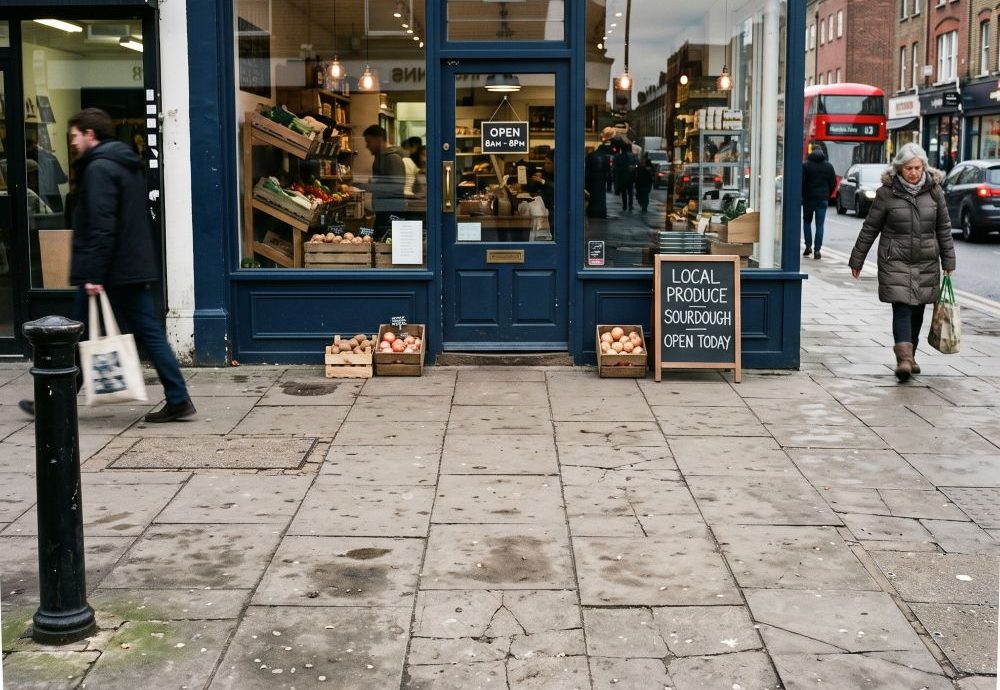
Keep Britain Tidy puts the figure at 99 per cent. That is the proportion of retail sites in England carrying visible chewing gum staining, against roughly 77 per cent of streets generally, which tells you something about where people stand when they decide they have finished with it. They stand outside a shop, looking in the window.
So the question comes up constantly, and it comes up angrily, because the retailer is the only party in the arrangement who has to look at it all day.
Whose pavement is it, in law?
The footway outside almost every London shop is adopted highway, maintainable at public expense, and it belongs to the highway authority. In Lewisham that is the borough. On a red route it is Transport for London as highway authority, though street cleansing on the Transport for London Road Network is generally still delivered by the borough, which is one of those arrangements that makes perfect sense until you need someone to come out.
Under section 89 of the Environmental Protection Act 1990, the council has a duty to keep relevant land and highways clear of litter and refuse. Section 41 of the Highways Act 1980 covers maintenance, which means the structure of the footway – the slabs, the levels, the trip hazards – and not the state of it. Two different obligations, often confused, and a retailer complaining about the surface of the pavement and a retailer complaining about the dirt on it are writing to two different departments.
Where does your demise stop?
Look at the lease plan before you assume anything. A standard high street shop lease demises the internal area to the inside face of the shopfront, and the threshold strip and the frontage beyond it are outside it. Some do not. A parade with a set-back frontage, a recessed doorway, a stall riser sitting behind a private forecourt strip a metre deep – those forecourts are frequently within the demise, and they are the bit that collects cigarette ends against the wall.
If the forecourt is demised to you, nobody else is coming to sweep it.
What is the council obliged to do, and how often?
Less than most retailers assume, and to a defined standard rather than an aspiration.
The Code of Practice on Litter and Refuse sets zone types by intensity of use and grades cleanliness from A down to D, with response times attached to restoring a fallen grade. A busy shopping frontage sits in a high-intensity zone with a short response time. A back service road does not. That is the whole architecture. The council promises to restore a defined grade within a defined window once it drops. Nowhere does it promise you a clean street.
Gum sits awkwardly in that system. Gum staining is bonded to the surface and needs heat, water and a machine. Routine litter picking does nothing to it. Councils treat it as periodic deep cleansing rather than something the morning barrow sweep picks up. Which is why a frontage on Deptford High Street can be swept every day and still look filthy from twenty feet.
Can the council make the cleaning your problem?
It can, and this is the part almost nobody knows about.
Sections 93 and 94 of the Environmental Protection Act 1990 give a council power to serve a street litter control notice on the occupier of premises where litter is a recurring problem in the vicinity. Fried chicken shops, coffee outlets, anywhere with takeaway packaging. The notice defines an area of frontage and requires the occupier to clear it, and non-compliance is an offence. If you are a food business on a busy stretch off Douglas Way, you may find that the pavement question has already been answered for you in writing.
What does the BID levy buy, and where does its remit stop?
A Business Improvement District is a five-year arrangement created under Part 4 of the Local Government Act 2003 and the 2004 regulations, funded by a levy on the rateable value of businesses inside a mapped boundary, voted in by ballot. The defining principle is additionality. Before a BID starts, it agrees a baseline services statement with the council recording exactly what the council already does, so the levy can only buy work on top of that.
In practice, street cleaning is the single most common thing a London BID spends money on: high-vis street teams, a jetting round, and very often a scheduled gum removal programme covering the main retail frontages.
Here is the part that costs me work. Before you commission gum removal privately, find out whether your levy already pays for it. Get the BID’s business plan and its annual report – both are published, both list the cleansing programme, and the good ones give you the actual frequency and the streets covered. Then ring them and ask when your stretch is next scheduled. I have quoted for frontage work three times in the past two years where the BID team was booked to do that exact pavement inside six weeks. Somebody is paying for that twice.
What if you are not in one?
Then say so out loud, because the map matters more than the postcode. A shop on Deptford High Street in SE8 and a shop by Lewisham Shopping Centre a mile and a half south are not in the same position at all, and boundaries follow street numbers, not neighbourhood names. Check the council’s BID page for the boundary map rather than assuming.
If you are outside a BID footprint, the other route is the council’s own gum budget. The Chewing Gum Task Force, established by Defra and run by Keep Britain Tidy, is funded by the gum manufacturers to the tune of up to £10 million across five years, and roughly fifty councils a year apply successfully for a share. Grants land in the region of £20,000 to £30,000 per authority and pay for a targeted deep clean of chosen streets. Councils choose those streets partly on where the pressure comes from.…
What Happens to an Office Kitchen After a Norovirus Outbreak?
Cleaning Tips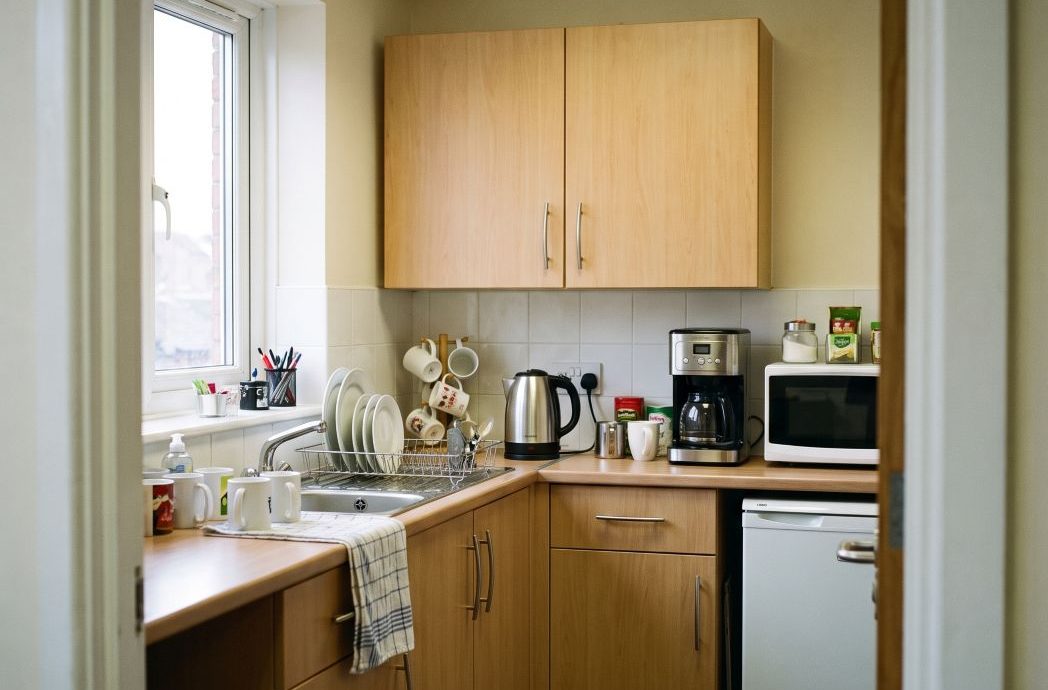
Go and press the start button on your office microwave. Now look at your finger. That keypad is touched by perhaps sixty people between nine and three, most of them holding a fork in the other hand, none of them having washed anything since they came out of the cubicle. The membrane is textured plastic with a raised grid, which means it holds soil in a way a flat surface does not, and in eleven years of doing this work I have never once seen an office cleaning specification that mentions it by name.
We were called into a floor off Chancery Lane in WC2A in February after nine people from a forty-two-person team went down inside four days. The facilities manager wanted the whole floor fogged. What the floor needed was a fortnight of somebody wiping four objects, six times a day, with the right chemical left wet for long enough. Those are different jobs and they cost very different money.
Why does the alcohol gel by the lift do nothing here?
Because norovirus has no lipid envelope.
Alcohol hand rub works by dissolving the fatty membrane that wraps viruses like influenza and SARS-CoV-2. Norovirus does not have one. It is a naked capsid, a protein shell around RNA, and it sits there in 70 per cent ethanol looking entirely unbothered. UKHSA says this plainly in every outbreak leaflet it publishes: alcohol gels do not kill it, and should not be relied on in place of washing hands with soap and warm water.
The dispensers by the lift lobby are not useless. They are useless against this. Every office I walk into during an outbreak has three of them and one dying paper towel dispenser in the washroom, and the ratio tells you where the budget went and who was in the meeting.
So what does that mean for the kit on the trolley?
Quaternary ammonium compounds – the “quats” in most general-purpose disinfectant sprays and the great majority of supermarket antibacterial wipes – have poor activity against non-enveloped viruses at in-use dilutions. If your cleaning contractor is going through an outbreak with a quat spray and a blue roll, they are polishing the virus into an even layer.
You want chlorine. Sodium hypochlorite, or a chlorine-releasing tablet made up fresh, at a known concentration.
Which surfaces matter, and which are we wiping to look busy?
The floor is close to irrelevant, and the floor is where most emergency deep cleans put their hours.
Norovirus moves by hand to mouth. The route is a contaminated fingertip touching something you then put in your face, so the surfaces that matter are the ones an unwashed hand touches on the way to eating. In an office kitchen, that is a very short list and it is the same list in every building I have worked in from Gray’s Inn Road to the Canary Wharf estate.
The fridge door handle. The microwave keypad and its door handle. The tap lever and the boiling-water tap dispenser button. The cupboard handle where the mugs live. The dishwasher door. After that, in the wider floor, it is the washroom door handle on the inside, which people pull with a clean hand and a paper towel if you have given them one, and with a bare hand if you have not.
Cutlery drawers matter more than people expect. Somebody with symptoms coming on reaches in and rummages for a teaspoon at half eight in the morning, and their hand contacts nine other spoons on the way to the one they take. That is where it lives.
How far does vomit travel?
Further than the mop bucket suggests. A projectile vomiting episode aerosolises virus across a radius of two to three metres, which in a typical London tea point puts it on the underside of the wall units, the kettle, the exposed edges of the worktop and the chair backs at the nearest bench. Cleaning a one-metre circle on the vinyl and calling it done is the most common failure I see, and it is why floors reinfect a week later. Contaminated soft furnishings and cloths go in a 60°C wash with detergent, and the fabric chairs within that radius need extraction or steam, not a spray-and-wipe.
What concentration of chlorine, and left on for how long?
This is the part that gets fudged, so here are the numbers.
For general surface disinfection during an outbreak, 1,000 parts per million available chlorine. For surfaces visibly contaminated with vomit or faeces, 5,000 ppm. Household thin bleach at around 5 per cent sodium hypochlorite is roughly 50,000 ppm, so 1,000 ppm is a one-in-fifty dilution: 20ml into a litre of cold water. Chlorine tablets are easier to control and I would use them in an office every time, because a cleaner making up bleach by eye at seven in the morning will make it too strong, ruin a worktop, and then make the next batch too weak out of guilt.
Contact time is where the whole thing falls down. Chlorine needs to sit wet on the surface for five minutes to do its work against norovirus. Five minutes is a very long time when you are wiping a fridge handle. What happens on real jobs is that an operative sprays and immediately wipes dry, because dry looks finished and wet looks like they have not been back yet, and the surface has then had about four seconds of contact. That is not disinfection. It is redistribution with a chlorine smell attached, which is worse, because everybody in the building now believes the kitchen is safe.
The instruction we give and audit against is: apply, leave, move on to the next item, come back. On a tea point with eleven touchpoints that produces a natural rotation and nobody has to stand and count.
Two practical consequences. Chlorine at 1,000 ppm will pit brushed stainless steel and will bleach fabric, so the worktop and the sink surround get a clean water wipe after the contact time has elapsed, and the chairs get a different product.…
What Can a Landlord Actually Charge You for Cleaning at the End of an Office Lease?
Cleaning TipsA tenant on Charlotte Street rang us in March, eleven weeks out from expiry on 4,200 square feet across two upper floors. He wanted everything: full deep clean, carpet extraction, ceiling tiles wiped down, kitchen extract certificated, glass in and out. His finance director had already signed the budget off. I asked whether he had seen the schedule of dilapidations yet. He had not. Nobody had served one. He was proposing to spend the better part of nine thousand pounds cleaning to a standard that no surveyor had yet written down, in the hope it would soften a claim he had not read.
We did the work in the end. About a third of it.
That gap – between what tenants assume they owe and what a landlord can lawfully recover – is where most of the money goes missing in a Fitzrovia lease exit. Cleaning is the part of dilapidations people feel confident about, because everyone understands dirt. It is also the part most often paid for twice.
What is a schedule of dilapidations asking you to do?
A terminal schedule is a list of alleged breaches of your lease covenants, served at or near the end of the term, usually with a quantified demand attached putting a figure against each line. The Pre-Action Protocol for dilapidations claims expects the landlord to serve it within a reasonable time, generally taken as 56 days after the term ends, with the tenant’s response due 56 days after that. It is a claim for damages for breach of contract. It is not an invoice for a service you have ordered.
That distinction has teeth. Because the payment compensates the landlord for a building returned out of covenant, HMRC treats dilapidations settlements as normally outside the scope of VAT – the position confirmed in Revenue and Customs Brief 2 (2022), effective from 1 April 2022, after eighteen months of the industry holding its breath. So when a landlord’s agent sends you a builder’s quote for the cleaning works plus VAT and calls it your liability, they have already told you something about how carefully the claim was assembled.
Where does the cleaning sit in the schedule?
Almost never under its own heading. Cleaning gets distributed. Some of it hides in the yield-up covenant, which in a standard institutional lease of a W1T upper floor might require the premises handed back “clean and tidy” or “in a clean and decorated condition”. Some of it sits inside repair items, where a stained ceiling tile is described as damaged rather than dirty. Some of it is smuggled into redecoration.
Read the covenant wording before you read the prices. A covenant to yield up clean is a different obligation from a covenant to keep in good and substantial repair, and the second one is subject to a statutory cap that the first one may not be.
Why does Section 18(1) put a ceiling on the bill?
Section 18(1) of the Landlord and Tenant Act 1927 is the most useful sentence in commercial property law and the least read. Its first limb says damages for breach of a covenant to keep or put premises in repair cannot exceed the amount by which the value of the landlord’s reversion is diminished by the breach. The second limb goes further: no damages at all where the premises are to be pulled down, or structurally altered in a way that would render the repair works valueless, shortly after the term ends.
Think about what that means for a floor in Fitzrovia in 2026. The landlord’s agent serves a £180,000 schedule. Meanwhile the asset manager has already appointed a Cat A contractor to strip the floor to slab, put in a new metal ceiling raft and an exposed-services scheme, and chase a higher rent from a tech tenant off Berners Street. The old mineral fibre grid is going in a skip in week two. Cleaning it achieves precisely nothing for the value of the reversion.
Surveyors call this supersession. The RICS professional standard on dilapidations in England and Wales, seventh edition, reissued in December 2023, includes a suggested letter for surveyors to send their landlord clients asking them to confirm their intentions for the building. Ask whether that letter was sent. Ask what the answer was.
What if the landlord will not tell you their plans?
Then look at the building. Scaffold licences, a planning application on the borough portal, a marketing brochure advertising a fully refurbished Grade A floor with a target availability date four months after your expiry – all of it is evidence, and none of it requires the landlord’s cooperation to find. A quantified demand is an opening bid. Surveyors who tell you otherwise are being paid by the other side.
Where does cleaning end and reinstatement begin?
This is where the real money sits, and where most disputes I see are won or lost.
Carpet tiles first. Almost every terminal schedule for a London office floor contains a line demanding replacement of the carpet, and almost every one of those lines is worth arguing with. Tiles have a design life. A fusion-bonded tile laid in 2013 and walked on by ninety people a day for twelve years has reached the end of it, and returning a landlord a floor covering in better condition than fair wear and tear would leave it is betterment, which you do not owe. Encapsulation cleaning will lift most traffic-lane soiling from a nylon tile and costs a fraction of replacement. It will not lift eleven years of ultraviolet fade along the south elevation, and no honest contractor will tell you it does.
Where a tenant has damaged tiles rather than worn them – a burst humidifier, an unbagged plant pot, a chair castor that has shredded the pile in one bay – the answer is often tile rotation. Pull matching tiles from beneath permanent storage or the under-desk zones, swap them into the visible areas, and put the damaged ones where nobody looks.…
Wembley Park and North-West London: How Commercial Cleaning Firms Are Scaling Up for the Area’s Office Growth
Cleaning TipsThe first time I priced a job on Olympic Way I did it the way I price everything else. Floor plate, occupancy, surface schedule, hours. The number came out sensible and it was wrong by a wide margin, because I had costed a building and Wembley Park does not work as a set of buildings. It works as an estate with a diary.
North-west London has been quietly assembling an office market while everyone kept looking at the towers east of the City. Brent has more commercial floor space around the stadium than it has had at any point since the old exhibition halls came down, and the occupiers are not the ones the postcode used to attract. Media, sport governance, housing associations, a growing set of professional services firms who worked out that a Jubilee line seat from Bond Street costs less than a Bank desk. Servicing that market takes a different operating model from the one most London contractors run.
What makes Wembley Park a different kind of contract?
Density and adjacency. In the City you take a floor in a tower and you book the goods lift, and that is the extent of your relationship with the world outside. The building behaves the same on a Tuesday as it does on a Saturday, and the pavement outside it empties at seven. At Wembley Park the office suite sits above a retail unit, next to a residential block, four hundred metres from a venue that can put ninety thousand people onto a single pedestrian route.
That proximity dictates everything downstream. Access windows compress. Loading bays are shared with retail deliveries and with event logistics. The waste stream from an office floor has to be moved through a service yard that is also handling food waste from Boxpark and the London Designer Outlet, and if you have not arranged that in advance, your night team is standing in a yard at half past ten with a cage of confidential shred and nowhere to put it.
One estate, many front doors
The mistake contractors make is treating each let as a separate mobilisation. You end up with four supervisors covering four buildings inside a fifteen-minute walk, four sets of consumables held in four cupboards, and nobody with the authority to move an operative from one to another when somebody calls in sick at nine at night.
We consolidated ours into a single estate team with one stores unit and a floating pair. The efficiency came from the walking distance, which sounds trivial until you count it. A supervisor at Canary Wharf who needs to reach a second building has a lift, a lobby, a bridge and another lift. Here they have a boulevard.
How does an events calendar reshape a cleaning rota?
Check the fixture list before you look at the floor plan. That is the single most useful piece of advice I can give anyone tendering for work in HA9.
An international at the stadium, a two-night arena residency, an NFL game with an American crowd arriving four hours early – each of these changes the soil profile of every office lobby within half a mile, because event footfall tracks through commercial entrances looking for lifts, toilets and shelter from rain. Entrance matting that copes with an ordinary Tuesday saturates by six in the evening on a match day and stays wet into the following morning, which is when the terrazzo behind it starts taking damage.
The rota therefore cannot be a fixed weekly pattern. Ours runs on a base schedule with event overlays, built from the published calendar at the start of each quarter and adjusted when fixtures move. Cup replays are the ones that catch people out, along with anything that goes to a Sunday kick-off after a Saturday arena show.
The overlay is mostly about matting, glass and washrooms, in that order. Everything else on an office floor is unaffected by a crowd that never got past the lobby, and there is no sense in paying for a full extra clean when the damage is concentrated in the first eight metres inside the door and in whichever toilets the public found.
Why event work belongs in its own contract line
Any contractor absorbing event-day cleaning into a standard square-metre rate is either losing money or delivering less than the specification says. I have seen both, and the second is more common, because the way it shows up is a lobby that looks acceptable at eight in the morning rather than an obvious failure.
Price it separately. A call-off rate per event with a stated crew size and a stated window, triggered from the fixture list. Define in writing which entrance matting and which hard floor falls inside it. Clients push back on this at tender and thank you for it in the second year, once they have seen what a wet November Saturday does to a marble threshold.
What does scaling up mean for the labour model?
Recruitment is where north-west London gives a contractor an advantage that central London cannot.
Night cleaning in EC2 depends on operatives travelling in from Newham, Barking and further out, which means a last-train problem at one end of the shift and a first-train problem at the other. Around Wembley the labour pool lives in Alperton, Stonebridge Park, Harlesden, within a bus ride. Retention on our Wembley Park contracts sits well above what we manage in the City. People are home in twenty minutes, and that beats a pay rise for most of the team.
That changes what you can offer. Split shifts become viable. Day cleaning becomes viable, and day cleaning is how you handle an estate where the events tail into the night and the office window keeps shrinking. An operative who can work seven till eleven in the morning and return for a four-hour evening block is worth two agency bookings, and they know the building.
The supervisor who lives in Alperton
Our estate supervisor at Wembley Park lives eleven minutes away on the 224.…
Steam Cleaning in Commercial Office Environments: Applications, Limitations, and London Case Studies
Cleaning Tips
Steam sells itself before anyone has seen it work. A client watches a demonstration and sees a stripe of clean appear on a filthy grout line. That is enough for most people to decide the machine solves the building. Then the same machine goes onto a carpet tile and the carpet tile looks worse.
The confusion is understandable, because steam is doing something quite narrow and the marketing describes something broad. What comes out of a commercial steam generator is dry saturated vapour at somewhere between four and eight bar, and its work is thermal and mechanical. Heat softens the bond between soil and substrate. Velocity shifts it. There is no chemistry involved beyond what heat does to fats, which means that on a surface where the soil is greasy and the substrate is hard, steam is the fastest tool in the van, and on a surface where the soil is particulate and the substrate is absorbent, it is close to useless.
What does steam do to soil that a mop cannot?
A mop moves soil around in a film of water. Steam breaks the adhesion and then you remove the soil with a cloth wrapped over the tool head. The removal step is the one people skip, and skipping it is why so many steam jobs look streaky an hour later.
Temperature is where the arguments start – every time, with every client. Manufacturers quote boiler temperatures of 150 to 180 degrees and clients repeat those figures back to me as though they describe what lands on the floor. They do not. Measure at the tip, not the boiler. By the time vapour has travelled down two and a half metres of hose and through a triangular floor tool, you are looking at surface contact temperatures in the region of 95 to 110 degrees, and that drops further with every centimetre of standoff distance. Hold the tool 40mm off a worktop and you have a warm damp draught.
Why the tip figure is the only one worth quoting
I carry an infrared thermometer for this reason and I check it in front of clients when the subject comes up, because it settles the conversation quickly and it stops people expecting sterilisation.
Thermal kill depends on temperature and dwell time together. A surface held at 100 degrees for several seconds behaves very differently from a surface passed over at walking pace. Anyone quoting a log reduction from a steam machine without stating the contact time and the tip temperature is selling you a number rather than a result.
Where does steam earn its place on a working office floor?
Take a conventional London office: reception, meeting rooms, a main working salon of open-plan desking, a tea point at one end. Most of that floor plate is carpet tile and most of it should never see a steam machine.
The value sits in the awkward eight per cent. Skirting junctions where a scrubber-drier cannot reach. The rubber transition strips at lift lobbies, which go black at the edges and stay black under any amount of detergent mopping. Kitchen splashbacks and the underside of tea point cupboard doors, where atomised oil settles into a film that a cloth smears rather than lifts. Door furniture. The tracks of sliding glass partitions, which fill with a paste of dust and lubricant that responds to heat and to nothing else.
We worked a floor in Farringdon where the tea point was tiled in a small white ceramic with grey grout that had been white when installed. Two operatives, one steam unit, a detail tool with a nylon brush, four hours. The client had been quoted for regrouting. Grout is porous, and porous surfaces hold soil below the plane where a cloth reaches, so heat and pressure at close range does what abrasion cannot without taking the grout with it.
The mistake with carpet tile
Steam on a loop-pile carpet tile puts moisture into a bitumen-backed product with no extraction to take it out. The face fibre looks brighter for a day. Then the moisture carries soil up from the backing by capillary action and the tile wicks, which shows as a dark ring or a general dulling across the treated area within seventy-two hours.
There is a legitimate use, and it is narrow: chewing gum removal and spot work on isolated marks, with the steam applied in short bursts and lifted immediately into a wet vacuum. Anything wider than a dinner plate belongs to hot water extraction or low-moisture encapsulation.
What changes when the space is a large retail floor?
Retail changes the arithmetic rather than the method. The soil is the same soil, but there is a great deal more of it and the surfaces are harder. Trading hours give you a four-hour window at night with nobody to work around, which is the one mercy.
We picked up a two-floor unit in Wood Green with polished concrete throughout and stainless steel on the till runs and the escalator balustrades. The concrete went to the machines. Steam did the fingerprint and cosmetic residue on the stainless, the escalator comb plates and the grout in the fitting room corridors.
Escalator comb plates are worth dwelling on because they are a case study on their own. The gap between comb and step fills with a black paste of shoe polymer, skin, textile lint and lubricant migrating out of the machinery. No detergent lifts it, because it is bound with oil and packed into a slot 3mm wide. A lance tool at close range emulsifies it in seconds, and the release comes out as a grey slurry that you catch with a cloth held below. It looks dramatic and the client always wants to watch.
The limitation in retail is throughput. A steam unit cleans perhaps eight to twelve square metres an hour on detail work. Scale that to a 2,000 square metre shop floor and the sums stop working, which is why I price steam in retail as a periodic detail visit sitting alongside the nightly machine clean rather than as a substitute for it.…
Acoustic Panel Cleaning in Modern London Offices: An Overlooked Task With Real Air-Quality Implications
Cleaning Tips
A fabric-wrapped acoustic panel is a filter. Nobody sold it as one, and the acoustician who specified it would object to the word, but a 50mm slab of mineral wool behind a stretched polyester weave, hung at head height in a room where forty people breathe eight hours a day, does what filters do. It catches things. Then it holds them, because there is no airflow through it and nothing to dislodge what has settled into the pile.
I have been cleaning London offices for long enough to remember when the walls were painted plasterboard and the noise problem was solved by putting people in rooms. Open plan changed that, and the fix arrived in fabric: wall panels, hanging rafts, felt screens, those honeycomb baffles that came in around 2018 and are now in every second office between Old Street and Aldgate. The acoustics improved. The cleaning specification did not change at all.
Why do acoustic panels collect more than ordinary dust?
Soft furnishings in an office behave like carpet turned sideways. The difference is that carpet gets vacuumed four or five times a week and a wall panel gets vacuumed when somebody notices a mark on it, which in practice means never.
The material matters. Most panels in the London market are polyester fibre or mineral wool wrapped in woven polyester or in a PET felt made from recycled bottles. Both weaves are open enough to let sound through – that is the entire point of them – which means they are open enough to let particulate through as well. Fine dust does not sit on the surface where a duster could take it off. It travels into the first few millimetres of the weave and lodges against the fibres, held there by static and by the tackiness that airborne cooking grease gives everything in an office with a kitchen on the same floor.
Static is the part people underestimate. A polyester weave in a dry, heated office in February carries enough charge to pull particulate out of moving air rather than waiting for gravity to deliver it.
What is in there when you take a sample?
I have had panel fabric tested twice, both times out of curiosity rather than because a client asked. The results were unglamorous and slightly disgusting: skin cells, textile fibres from clothing, and the fine black grit that comes off the Underground and travels into buildings on coats and shoes.
That last one is the London-specific problem. Anyone who has wiped a windowsill in a building above a deep tube line knows the colour of it. It is iron oxide and carbon, thrown off by braking and by wheel-rail contact, and the particles are small enough to stay airborne for hours. They settle into fabric and they stain it grey-brown from the inside, which is why panels in Bank or Moorgate offices look tired at four years while the same product in a Richmond business park still looks new.
What does a loaded panel do to the air people are breathing?
Here is where I will be blunt, because the industry tends to hedge on this and I think the hedging is dishonest. A dirty acoustic panel is a reservoir. Reservoirs release.
Anything mounted on a wall in an occupied office is subject to disturbance – doors swinging, air conditioning throw, someone shoving a chair back against a panel. Each disturbance re-suspends a fraction of what has accumulated. The dose is small on any given occasion and the accumulation is what counts, because the panel has been concentrating four years of airborne material into a surface that sits a metre from somebody’s face.
Then there is moisture. Panels near a poorly balanced AC diffuser see condensation cycles, and mineral wool that goes damp and dries repeatedly with organic material in it will grow things. I have pulled panels off walls in Hammersmith and found the back face spotted black where the plasterboard behind was cold. The room smelled faintly of a caravan. Everyone in it had been complaining of headaches for eighteen months, and the facilities team had been chasing a ventilation system that was working perfectly.
Nobody writes panel condition into an indoor air quality survey. Those measure CO2, particulate counts and volatile compounds in the air on the day, which tells you about the ventilation and nothing whatever about the twelve square metres of loaded fabric on the north wall.
The Canary Wharf job that changed how I quote
Bank Street, E14, in a fit-out five years old when we picked up the contract. Two floors, roughly 340 square metres of fabric-wrapped panelling and about ninety hanging rafts over the desks. The rafts were the ones that got me. They were pale grey when installed and pale grey from below, because you view a raft edge-on and the dust is on the top face.
We got a ladder up. The top surface of every raft carried a mat of grey lint three or four millimetres thick that you could have lifted off in one piece, and near the kitchen it had gone tacky and darker where the extraction had never been up to the job. Five years of it. The client had been paying for a nightly clean that entire time and the specification ran to floors, desks, glass, kitchens, washrooms. No panels, no rafts. Nobody had written it into the spec, so nobody had looked.
We sent the photographs up and got the response I have come to expect: surprise, then a question about whether it was safe. Five years of concentrated office air sitting above people’s heads is some way short of dangerous, and I would still not want it over my own desk.
How do you clean an acoustic panel without destroying it?
Carefully, and mostly dry.
The first rule is that you do not treat a panel like upholstery. Upholstery has a substrate that tolerates moisture and agitation. An acoustic panel has mineral wool or loose polyester fibre behind a fabric stretched onto a frame under tension, and both the core and the tension are ruined by water.…
How To Prepare Your Team For The Sheer Scale Of Corporate Commercial Cleaning
Cleaning TipsThere’s something a bit humbling about walking into a skyscraper and realising it’s your job to make sure every floor, lift, kitchen, toilet, and glass wall is spotless. Corporate cleaning isn’t a quick vacuum and wipe-down. It’s a full-on operation. One that runs like a machine—or at least it should. If you’re heading into large-scale commercial cleaning, your team needs more than elbow grease. They need structure, training, coordination, and seriously good gear.
That sheer scale? It catches plenty of newer cleaning firms off guard. I’ve seen it. Teams freeze up. Equipment breaks. People argue. And the client watches, unimpressed, because they don’t want excuses—they want results. This type of cleaning isn’t forgiving. You’re working in sensitive environments: boardrooms with million-pound contracts lying around, offices with constant foot traffic, conference centres being flipped overnight. There’s no wiggle room for chaos.
So the question is: how do you get your team ready for that level of pressure? How do you stop them from getting overwhelmed? Well, it starts with preparation. And not the rushed kind where you scribble names on a rota the night before. I’m talking long-term thinking. Solid systems. Real teamwork.
Let’s break it down properly. I’ve listed five key areas every cleaning business needs to focus on if you’re stepping into the big leagues of corporate commercial cleaning. Ignore them, and you’ll struggle. Nail them, and you’ll start running operations like clockwork.
Constant Growth: Keep Training, Keep Improving
Don’t Let Skills Stagnate
Commercial cleaning isn’t static. New products come out all the time. So do new materials, new surface finishes, and new compliance regulations. Your team can’t rely on what they learnt five years ago. Even basic techniques evolve. Microfibre cloths. HEPA filter standards. Anti-viral fogging. If you’re not keeping up, you’re falling behind.
That’s why I make training a regular part of our schedule. Not once a year. Monthly. Short sessions. Practical demos. Sometimes I’ll bring in outside experts. Other times, it’s a refresher on how to tackle high-gloss marble without scratching it to hell. Either way, the point is: never stop training.
Build Confidence Through Knowledge
A confident cleaner works faster, makes fewer mistakes, and doesn’t panic when the job changes last minute. Training builds that. It also creates a sense of pride. You’re not “just” a cleaner—you’re a trained professional who knows how to treat delicate surfaces, handle expensive equipment, and deal with difficult clients without flinching.
It doesn’t have to cost much either. Online videos. Manufacturer tutorials. Peer-to-peer coaching. A little time invested each month pays off massively when you’re sending people into buildings worth millions.
Precision Planning: Never Wing It
Create A Proper Cleaning Plan
Large-scale corporate cleaning doesn’t work without planning. You can’t show up with a mop and hope for the best. I start every contract with a walkthrough. I take notes on square footage, traffic flow, material types, client preferences, and key timings. Then I build a detailed cleaning plan.
Who’s cleaning what? In what order? What’s the most efficient route through the building? Where’s the backup stock stored? What happens if a toilet floods at 6 PM during an event? All that should be mapped out ahead of time.
Use Rotas, Checklists, And Digital Tools
I use digital checklists that cleaners tick off in real time. That way, supervisors can see progress live. I also rely on cleaning rotas tailored to each building’s rhythm. High-traffic toilets might need hourly checks. Executive meeting rooms might need a fresh polish before 9 AM, like clockwork.
Tools like Clean Smarts, Jobber, or even simple Google Sheets can make planning much sharper. Paper rotas are fine, but digital systems catch errors quicker. If someone misses a floor, I want to know immediately—not when the client calls me fuming.
Sort Your Team: No Drama, No Delay
HR Micromanagement Isn’t Optional
Big jobs fall apart when there’s friction in the team. You can’t run a 20-person cleaning shift across five floors if two supervisors aren’t talking to each other, or if one team member refuses to take direction. I’ve had to pull cleaners off site mid-shift because they couldn’t cooperate—and that’s a nightmare no one needs.
Micromanage HR? Absolutely. Get involved. Know who’s clashing. Mediate early. Don’t wait for resentment to fester. Your job isn’t just assigning tasks. You’re managing personalities under pressure.
Build A Culture Of Respect And Discipline
You can’t afford time-wasters or people who treat it like a side hustle. Cleaning massive office spaces or events means every person must pull their weight. So I run my team like a tight unit. Respect, professionalism, and punctuality are non-negotiable. We laugh, sure. We joke. But when it’s time to scrub, we scrub.
Every cleaner should know what’s expected of them. And they should also feel heard. Morning briefings and post-job debriefs help keep things transparent. If there’s a problem, I want it on the table—not whispered in the corridor.
Gear Up: Invest In Professional Equipment
The Right Tools Make The Job Easier
Cheap vacuums won’t survive commercial sites. Domestic mops won’t cut it across thousands of square metres. You need industrial-grade gear, and you need it working at full capacity. That includes ride-on scrubbers for huge floors, HEPA vacuums for allergy-sensitive zones, wet vacs for emergencies, and foggers for sanitising after office parties or illness outbreaks.
You’ll also need decent trolleys, microfibre cloths, colour-coded systems, and stock that doesn’t run out halfway through a shift. Trust me, nothing kills momentum like a team running around trying to find more bin liners at 1 AM during a conference teardown.
Maintain Everything Religiously
I’ve got a full maintenance calendar for every machine. Filters changed. Batteries charged. Pads replaced. Because nothing screams “unprofessional” like a floor buffer that screeches or sprays water across a corridor carpet.
Also: train your team on the gear. Don’t just assume they’ll know how to use a ride-on properly or refill a sanitiser fogger safely. One mistake could wreck a client’s floors or cause an injury. And then you’re in real trouble.…