What Happens to an Office Kitchen After a Norovirus Outbreak?
Cleaning Tips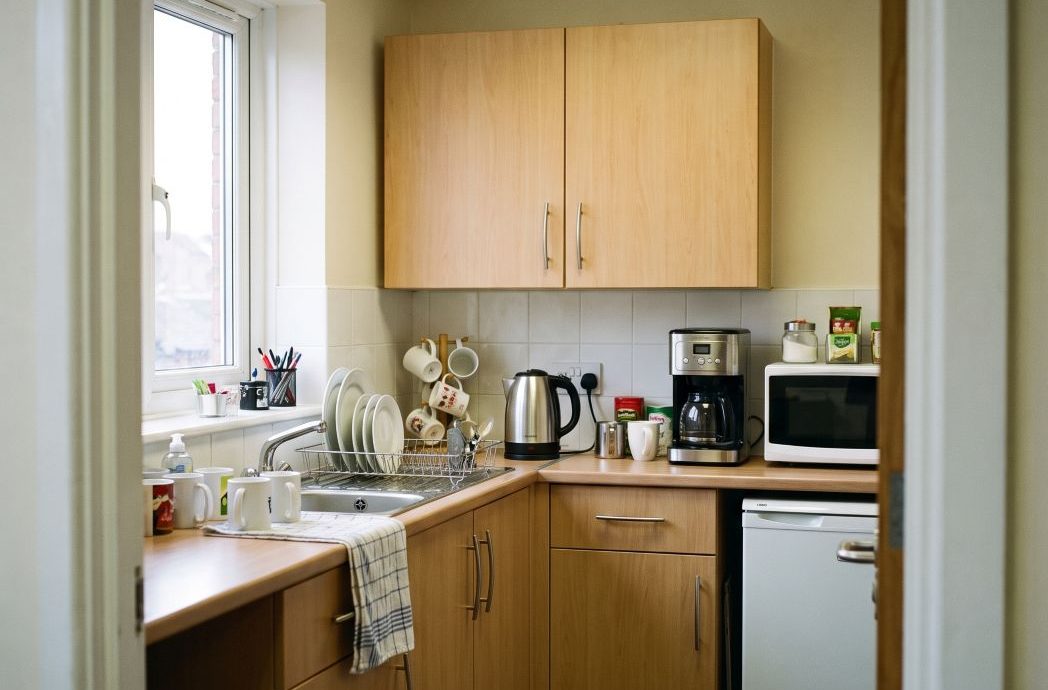
Go and press the start button on your office microwave. Now look at your finger. That keypad is touched by perhaps sixty people between nine and three, most of them holding a fork in the other hand, none of them having washed anything since they came out of the cubicle. The membrane is textured plastic with a raised grid, which means it holds soil in a way a flat surface does not, and in eleven years of doing this work I have never once seen an office cleaning specification that mentions it by name.
We were called into a floor off Chancery Lane in WC2A in February after nine people from a forty-two-person team went down inside four days. The facilities manager wanted the whole floor fogged. What the floor needed was a fortnight of somebody wiping four objects, six times a day, with the right chemical left wet for long enough. Those are different jobs and they cost very different money.
Why does the alcohol gel by the lift do nothing here?
Because norovirus has no lipid envelope.
Alcohol hand rub works by dissolving the fatty membrane that wraps viruses like influenza and SARS-CoV-2. Norovirus does not have one. It is a naked capsid, a protein shell around RNA, and it sits there in 70 per cent ethanol looking entirely unbothered. UKHSA says this plainly in every outbreak leaflet it publishes: alcohol gels do not kill it, and should not be relied on in place of washing hands with soap and warm water.
The dispensers by the lift lobby are not useless. They are useless against this. Every office I walk into during an outbreak has three of them and one dying paper towel dispenser in the washroom, and the ratio tells you where the budget went and who was in the meeting.
So what does that mean for the kit on the trolley?
Quaternary ammonium compounds – the “quats” in most general-purpose disinfectant sprays and the great majority of supermarket antibacterial wipes – have poor activity against non-enveloped viruses at in-use dilutions. If your cleaning contractor is going through an outbreak with a quat spray and a blue roll, they are polishing the virus into an even layer.
You want chlorine. Sodium hypochlorite, or a chlorine-releasing tablet made up fresh, at a known concentration.
Which surfaces matter, and which are we wiping to look busy?
The floor is close to irrelevant, and the floor is where most emergency deep cleans put their hours.
Norovirus moves by hand to mouth. The route is a contaminated fingertip touching something you then put in your face, so the surfaces that matter are the ones an unwashed hand touches on the way to eating. In an office kitchen, that is a very short list and it is the same list in every building I have worked in from Gray’s Inn Road to the Canary Wharf estate.
The fridge door handle. The microwave keypad and its door handle. The tap lever and the boiling-water tap dispenser button. The cupboard handle where the mugs live. The dishwasher door. After that, in the wider floor, it is the washroom door handle on the inside, which people pull with a clean hand and a paper towel if you have given them one, and with a bare hand if you have not.
Cutlery drawers matter more than people expect. Somebody with symptoms coming on reaches in and rummages for a teaspoon at half eight in the morning, and their hand contacts nine other spoons on the way to the one they take. That is where it lives.
How far does vomit travel?
Further than the mop bucket suggests. A projectile vomiting episode aerosolises virus across a radius of two to three metres, which in a typical London tea point puts it on the underside of the wall units, the kettle, the exposed edges of the worktop and the chair backs at the nearest bench. Cleaning a one-metre circle on the vinyl and calling it done is the most common failure I see, and it is why floors reinfect a week later. Contaminated soft furnishings and cloths go in a 60°C wash with detergent, and the fabric chairs within that radius need extraction or steam, not a spray-and-wipe.
What concentration of chlorine, and left on for how long?
This is the part that gets fudged, so here are the numbers.
For general surface disinfection during an outbreak, 1,000 parts per million available chlorine. For surfaces visibly contaminated with vomit or faeces, 5,000 ppm. Household thin bleach at around 5 per cent sodium hypochlorite is roughly 50,000 ppm, so 1,000 ppm is a one-in-fifty dilution: 20ml into a litre of cold water. Chlorine tablets are easier to control and I would use them in an office every time, because a cleaner making up bleach by eye at seven in the morning will make it too strong, ruin a worktop, and then make the next batch too weak out of guilt.
Contact time is where the whole thing falls down. Chlorine needs to sit wet on the surface for five minutes to do its work against norovirus. Five minutes is a very long time when you are wiping a fridge handle. What happens on real jobs is that an operative sprays and immediately wipes dry, because dry looks finished and wet looks like they have not been back yet, and the surface has then had about four seconds of contact. That is not disinfection. It is redistribution with a chlorine smell attached, which is worse, because everybody in the building now believes the kitchen is safe.
The instruction we give and audit against is: apply, leave, move on to the next item, come back. On a tea point with eleven touchpoints that produces a natural rotation and nobody has to stand and count.
Two practical consequences. Chlorine at 1,000 ppm will pit brushed stainless steel and will bleach fabric, so the worktop and the sink surround get a clean water wipe after the contact time has elapsed, and the chairs get a different product. And chlorine is inactivated by organic soil, which brings us to the thing almost everybody gets backwards.
Why does the order matter more than the product?
Clean first, disinfect second. Two stages, two cloths.
Grease, milk residue, coffee splash and crumb all consume free chlorine before it reaches the virus. Spraying disinfectant onto a soiled fridge handle spends most of the active ingredient on last Tuesday’s oat milk. Detergent clean, rinse, then chlorine at the stated concentration with the stated dwell time. Every operative we send to an outbreak job carries two spray bottles and colour-separated cloths for exactly this reason, and the second stage is the one that gets dropped when the client is standing in the doorway asking how much longer.
Is a full-floor fog worth the money?
Mostly not, and I will lose work saying so.
Fogging or misting a whole floor with a hydrogen peroxide or hypochlorous solution has real uses. Sealed rooms, healthcare settings, an area you can evacuate and leave for hours. In a Chancery Lane office with a raised floor, an open plan of 6,000 square feet, forty desks with monitors and keyboards on them, and a landlord’s air handling running, the value drops considerably. Fog settles on the top surfaces it can reach. It does not get to the underside of the fridge handle, which is the part your hand grips. It does not lift organic soil, so the same inactivation problem applies. And it usually goes in on a Saturday, after which people return on Monday and start touching each other’s things again by ten past nine.
It photographs well. There is a man in a white suit, there is visible vapour, there is an invoice, and the facilities manager has something to send to the partners. I understand entirely why it gets bought.
What would we do with that budget instead?
Two things, and neither is glamorous.
Hand drying. Wet hands transfer far more organism than dry ones, and half the buildings I visit have a single warm air dryer for a floor of ninety people with a queue at ten past one. Paper towels with enough bins to hold them, restocked twice a day for the duration, will do more than any fogging pass.
Then frequency. Take the cost of one fogging visit and convert it into a fortnight of touchpoint rounds – four passes a day on the kitchen and washroom furniture, two stages, correct dwell. That’s where it lives, and that is where the money should go.
How long does the heightened regime run?
Until 48 hours have passed since the last person’s last symptom, and then a week beyond that for safety.
The UKHSA exclusion is the firmest number in this whole article: anyone who has been sick or had diarrhoea stays away from work until they have been clear for at least two full days. Not until they feel better. Two days after the last episode, because shedding continues well past the point at which somebody feels able to sit at a desk.
Who breaks it?
Your building will. Someone with a deadline comes in at 36 hours, use the boiling water tap, and hand you a second wave the following Thursday. That is where it lives, and no amount of chlorine reaches it.
The Chancery Lane floor had no further cases after the second week. We charged them for eleven days of enhanced touchpoint work and a case of paper towels.